Building from scratch the e-commerce ecosystem for an artisanal luxury millinery brand
Project
E-commerce, Product Design, Growth, and AI
I designed, developed, and continue to lead this project entirely solo: strategy, product design, Shopify development, branding, content, analytics, acquisition, CRM, and AI automation are completely my responsibility, without any agency or external team.
Between January and March 2026, I built the Gorka González Brand e-commerce platform from scratch on Shopify and launched it in March. My work covers digital product definition, UX/UI, development, launch, branding, content, analytics, acquisition, CRM, automation, artificial intelligence, and operations.
The project transformed a digital presence without its own sales channel into an active, measurable, and continuously evolving commercial ecosystem in just three months of building. Since launch, the brand has generated online orders and revenue, automated processes, and produced in-house content for the e-commerce store, campaigns, and social media—laying a solid foundation to optimize the business, scale, and enter new markets.
Workspaces
Visit website

01 The challenge: bringing artisanal value into the digital space
Gorka González Brand is a luxury artisanal millinery brand whose brand and sales experience was traditionally rooted in physical spaces. The challenge was to build a digital channel from scratch—one capable of conveying the product's value, explaining its customization options, and building the trust required for online purchasing.
The solution had to preserve the brand's premium, artisanal identity while connecting the shopping experience, customer acquisition, data, communication, and operations within a system built to scale.
02 An End-to-End E-commerce Ecosystem
I designed and connected both the front-end customer experience and the back-end infrastructure, tools, integrations, and processes required to run the e-commerce business. The result is an integrated system where every interaction generates data, triggers processes, and informs the next decision.
The architecture is built around Shopify as the core of the ecosystem, connecting:
E-commerce and product: catalog, inventory, customization, cart, checkout, and order management.
Payments: Shopify Payments, PayPal, Apple Pay, and Google Pay.
Google Ecosystem: GA4, Google Tag Manager, Google Ads, Search Console, Merchant Center, Business Profile, and Consent Mode.
Analytics and user behavior: Hotjar and Contentsquare.
Meta and Social Commerce: Meta Ads, Meta Pixel, Meta Catalog, and Instagram Shopping.
CRM and automation: Klaviyo, segmentation, campaigns, and automated customer journeys.
Billing and accounting: Holded and TicketBAI.
Shipping and tracking: logistics setup, shipping management, and tracking via Mailbox.
Digital infrastructure: domain, DNS, corporate email, transactional email, and associated technical setup.
Privacy and consent: cookie management, tracking consent, and integration with analytics and advertising platforms.
Content and communication: e-commerce, Social Media, Paid Media, and email marketing.
As a result, the e-commerce store functions as a connected business ecosystem rather than an isolated storefront. Product, payments, acquisition, analytics, CRM, Social Commerce, logistics, billing, and technical infrastructure evolve under a single strategy, turning every interaction into actionable data and every data point into an optimization opportunity.
This infrastructure connects the entire customer journey and post-purchase operations, as shown in the diagram.

03 Product Design, UX/UI & Shopify
I built the e-commerce store from scratch on Shopify and took ownership of its end-to-end design and evolution: information architecture, customer journeys, navigation, catalog, product pages, customization options, responsive design, purchase flows, and checkout.
This foundation transformed the artisanal offering into a clear, intuitive digital experience and allowed us to iterate based on real usability data. Since then, I have treated the platform as a living product: identifying friction points, prioritizing enhancements, and developing new features to streamline the buying process and boost conversion rates.
Data analysis revealed a trust-related friction point that the funnel itself wasn't showing: 70% of sales for this high-value, artisanal product were closed through assisted chat on WhatsApp, rather than at checkout. I prioritized this as the highest-impact roadmap item: designing a human touchpoint directly within the purchase flow—via a visible WhatsApp chat or CTA on product pages and checkout—instead of letting this support happen in an improvised way off-site.
This solution is already live: I implemented a floating WhatsApp button visible site-wide, giving users direct access to customer support from any page without having to reach the product page or checkout first. This is the first piece of the trust-building roadmap now in production.

04 Branding, Creative Direction, and Brand Experience
I defined the digital application of the brand identity and seamlessly integrated it across the e-commerce platform, campaigns, social media, paid media, and CRM.
The art direction highlighted the product's craftsmanship, reinforced its premium positioning, and established a scalable design system. This ensured consistency across all touchpoints, accelerating production times without diluting the brand's identity.
Additionally, I placed strategic importance on editorial and video production as key tools to build an aspirational brand universe, drive product desire, and spark purchase intent.


05 Data, Analytics, and CRO
I implemented and integrated Shopify, GA4, Hotjar, Klaviyo, Meta, and various acquisition channels, building a unified infrastructure to understand user behavior, analyze the complete customer journey, and pinpoint friction and drop-off points within the funnel.
Navigation, conversion, campaign, and CRM data are continuously gathered, cross-referenced, and audited. This analysis is translated into concrete hypotheses and actionable steps across product, UX, content, automation, campaigns, and business strategy.
A full-funnel analysis of 5,181 sessions revealed exactly where drop-offs were occurring: only 1.85% of sessions added a product to the cart, and just 0.38% reached the checkout. However, the most telling insight emerged when cross-referencing this data with actual sales: of the 10 total orders during this period, only 3 were completed autonomously through the online checkout. The remaining 7 originated on the website but required assisted sales via WhatsApp to close. Indeed, 70% of sales for a handcrafted product priced at €300+ relied on human interaction to resolve doubts before purchasing—a need that the self-service online funnel was neither communicating nor facilitating.
Mobile traffic accounted for nearly 90% of sessions but converted at a lower rate than desktop, establishing mobile UX optimization as our number one priority. The audit also detected 6% automated bot traffic, which was excluded from the analysis to prevent data skewing.
Every insight is prioritized, transformed into an optimization hypothesis, and re-measured post-implementation, establishing a continuous CRO process driven by real data, not assumptions.

06 Content, Social Media and Acquisition Funnel
I built and lead the digital acquisition system, aligning content strategy with e-commerce business goals.
The funnel integrates organic content, Social Media, Meta Ads, and Google Ads to guide the user from first touchpoint to product discovery and conversion. This framework transformed acquisition into a measurable and optimizable process, rather than a series of isolated campaigns.
An ad audit cross-referencing Shopify, Meta Ads, and GA4 revealed that Meta Ads spend drove engagement —92 adds to cart, 8 checkouts initiated— but only 3 attributed purchases, an insufficient return to prove a profitable and scalable channel after €724.64 in ad spend. I identified two main bottlenecks: optimizing for mid-funnel events (Add to Cart) instead of Purchases, and budget concentration on too few creatives, lacking a structured testing pipeline.
Based on this audit, I designed and managed a phased paid media budget: a gated allocation model where subsequent ad spend is unlocked only when the previous tier meets objective decision criteria —minimum purchase volume, maximum CAC, and minimum ROAS—, rather than scaling spend based on gut feeling or calendar dates.
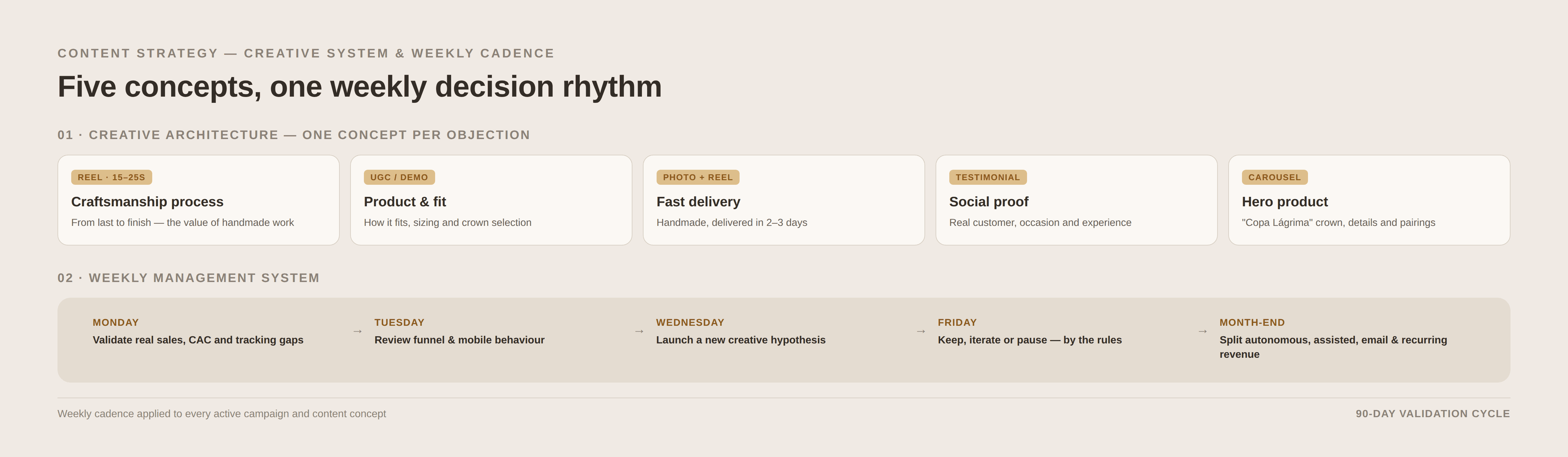
I designed the creative architecture of the new cycle around five key angles, each addressing a specific friction point identified in the audit: artisanal craftsmanship (from lasting to finishing, via Reels), product fit (UGC content showcasing sizes and cup selection), fast shipping (2-3 day delivery as a competitive edge), social proof (real customer reviews), and the hero product (Teardrop Cup as the catalog's focal point, via Carousel Ads).
To maintain high-tempo decision making, I implemented a weekly management cadence: on Mondays, I review actual revenue, CAC, and attribution discrepancies; on Tuesdays, funnel conversion and mobile behavior; on Wednesdays, I launch a new creative hypothesis; and on Fridays, I decide whether to scale, iterate, or pause campaigns based on our predefined rules. At month-end, I isolate direct, assisted, email, and returning revenue to avoid diluting performance signals.

07 Klaviyo and customer lifecycle automation
I designed and implemented a CRM and email marketing architecture in Klaviyo, connected directly to user behavior within the e-commerce platform.
I built automated journeys for acquisition, discovery, abandonment, conversion, post-purchase, upselling, retention, and win-back, structured across four key stages:
Acquisition · Welcome, subscription, brand education, and product discovery.
Conversion · Product added to cart, abandoned checkout, first purchase, and handling objections.
Intent · Identifying high-intent behaviors and delivering personalized assistance.
Relationship · Post-purchase, upselling, retention, reactivation, and win-back.
A performance audit revealed that while the welcome flow drives strong engagement (a 38.6% open rate on the first email), the actual coverage of recovery flows is low. The abandoned cart flow reaches only 11.5% of actual carts, and the abandoned checkout flow reaches barely 5% of users who initiate checkout. The diagnosis points to an issue with user identification and event triggering, not content. Before optimizing email copy, we need to fix behavioral tracking and user consent.
With that fix as a prerequisite, the system is designed to evolve from broadcast communications toward increasingly personalized experiences with greater actual coverage across each user's journey.


08 AI Applied to E-commerce and Business
I designed AI workflows to automate tasks, accelerate analysis, and transform scattered data into actionable decisions. These workflows cross-reference business data, generate audits and reports, detect patterns and anomalies, and identify opportunities that translate directly into prioritized product, marketing, content, and business recommendations. The very audit report supporting this case study—integrating Shopify, Meta Ads, Klaviyo, and Contentsquare—is a direct example of this system in action.

09 Generative AI, Generative Fill, and In-House Production
By leveraging generative AI workflows, I transformed the brand's creative production model and brought the ongoing generation and adaptation of content in-house for e-commerce, campaigns, and social media.
I use image and video generation, generative fill and expansion, editing, asset transformation, prompting, and automation to create assets, adapt formats, and build multiple versions tailored to the channel, campaign, or audience.
Production · Image and video generation, asset editing, and transformation.
Generative Fill · Background modification, frame expansion, contexts, and compositions.
Scalability · Formats and versions adapted to channels, campaigns, and audiences.
Operations · 100% in-house creative production, significantly reducing time-to-market from concept to launch.
The result is a more agile, autonomous, and scalable in-house creative capability: we can iterate faster, produce more formats, and maintain brand control while reducing dependency on external agencies.

10 Impact and results
The project transformed a primarily offline operation into a connected and measurable e-commerce ecosystem. The brand went from having no direct online sales channel to generating traffic, orders, and actionable customer insights.
Instead of scaling spend without evidence, I designed and executed a comprehensive growth audit crossing five data sources—Shopify, Meta Ads, Klaviyo, Contentsquare, and WhatsApp—to pinpoint exactly where conversion was dropping off and why.
Key findings: the bottleneck lies between product view and the purchase decision, not in traffic, inventory, or margin; 70% of actual sales required human assistance via WhatsApp to close, revealing a trust friction that the online funnel couldn't resolve alone; the mobile experience (≈90% of traffic) underperformed compared to desktop; ad spend generated only 3 attributed orders after €724.64, an unproven efficiency; and the automated CRM architecture had limited actual coverage over drop-off events.
Based on this diagnosis, I decided not to scale spend until measurement and experience were corrected, and I defined a 90-day action plan with budget released in phases and objective decision rules based on CAC and purchase ROAS before authorizing each tranche.
What has already been built:
New sales channel · The brand went from having no direct online sales channel to generating orders—10 in the last audited period—and digital revenue, establishing a direct relationship with its customers.
Measurable digital reach · The ecosystem exceeded 5,000 sessions during the audited period, with sufficient instrumentation to detect real patterns within the funnel.
Friction turned into product decisions · The audit identified specific barriers in the mobile experience, checkout, and purchasing trust, which were transformed into a prioritized 90-day roadmap.
Designed customer lifecycle · Klaviyo connects acquisition, welcome, abandonment, post-purchase, retention, and reactivation through journeys tailored to user behavior, with a coverage diagnosis already identified for its next iteration.
Operational autonomy · Routine content production is handled entirely in-house, while Shopify, payments, CRM, analytics, advertising, logistics, and invoicing are connected within a single architecture.
The result is a digital ecosystem capable of generating business, rigorously measuring its own performance, and using data to decide when to scale and when to optimize before investing more.
"The goal wasn't to show short-term volume, but to build the data infrastructure and decision rules that allow scaling with confidence when the business demands it—the system is designed to handle a much higher order volume than current levels without changing the architecture."

